I am a PhD candidate at the Universitat Politècnica de Catalunya (UPC) and work in the
Accelerators and Communications for HPC (AccelCom) group of the
Barcelona Supercomputing Center (BSC).
My research is about integrating quantum processors into high-performance computing:
how to schedule, distribute and orchestrate quantum workloads alongside classical resources in a supercomputing centre.
My background combines physics and computer engineering: an MSc in Computer Engineering,
studies in Advanced Physics and Data Science, and the MIT MicroMasters in Statistics and Data Science.
Before the PhD I worked as a data scientist and machine learning engineer on cloud-native (AWS) systems.
Publications list me as Ricard S. Raigada-García or R. S. Raigada García.
What I am working on now. Published work links to its paper; ongoing work is described by the question it addresses.
The research map shows how these lines connect.
Quantum work under HPC resource management
Public Preprint and ACM ICS 2026 poster
Quantum jobs usually bypass the scheduler that runs the rest of a supercomputer.
I build runtimes that turn quantum work into units the centre’s resource manager can queue, route and recover,
across local QPUs, remote QPUs and classical simulators.
Large quantum simulations and long hybrid quantum–classical campaigns need different resources at different moments,
and a shared machine changes what it can offer over time.
This line studies how such workloads can adapt to the allocation available while they run, and survive interruptions.
Data movement in distributed quantum simulation
Ongoing
When a quantum state is spread across many nodes, communication between them often dominates the runtime.
I study which decisions taken before a run determine that cost, and how a system can make them automatically.
The integration layer of quantum-centric supercomputing
Doctoral thesis In progress
Coupling quantum processors to a supercomputer raises a systems question: where should coordination between
classical and quantum resources live, and what should it cost? My doctoral thesis addresses this layer.
Íñigo Aréjula-Aísa, Sergio Iserte, Petter Sandås, Ricard S. Raigada-García, Antonio J. Peña
arXiv:2610.09659 [cs.DC]
A communication-aware qubit-layout framework that reduces inter-node data exchange while selecting the number of computational nodes automatically. Integrated into QuCSLO, it supports dynamic node scaling, OpenQASM parsing and QuEST; evaluations on synthetic and QASMBench circuits show fewer communication cuts and runtime speedups above 2× over identity layouts, particularly for highly entangled circuits.
@misc{arejulaaisa2026communication,
  title = {{Communication-Aware Qubit Placement and Automatic Node-Count Allocation for Distributed State-Vector Simulation}},
  author = {Aréjula-Aísa, Íñigo and Iserte, Sergio and Sandås, Petter and Raigada-García, Ricard S. and Peña, Antonio J.},
  year = {2026},
  eprint = {2610.09659},
  archivePrefix = {arXiv},
  primaryClass = {cs.DC},
  url = {https://arxiv.org/abs/2610.09659}
}
Ricard S. García-Raigada, Josep Jorba, Sergio Iserte
arXiv:2604.15279 [cs.DC]
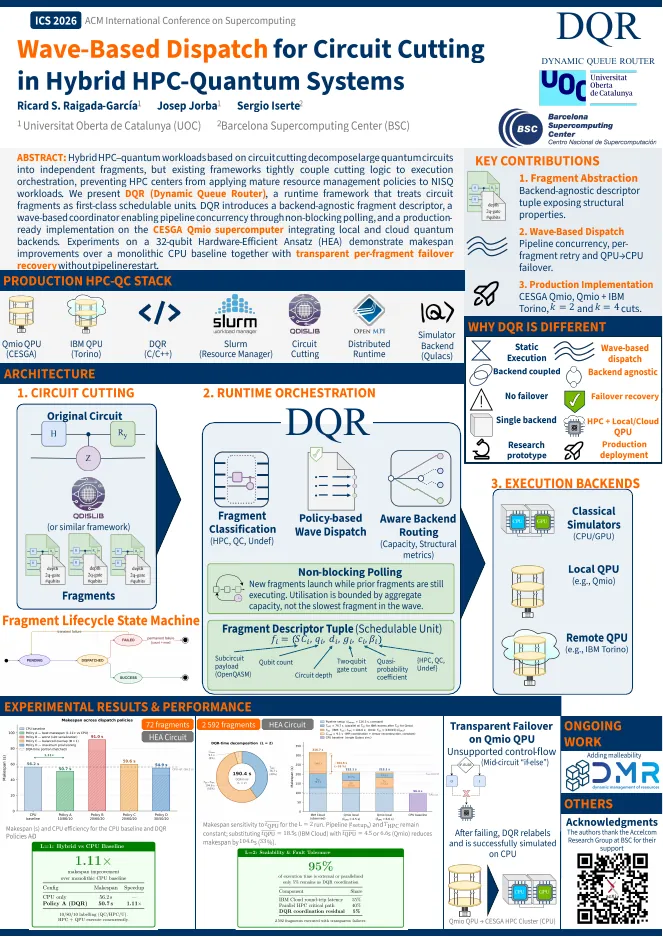
DQR (Dynamic Queue Router), a runtime that treats circuit-cutting fragments as schedulable units, so HPC centres can apply standard resource management to NISQ workloads. Evaluated on the CESGA Qmio supercomputer with its local QPU and the remote IBM Torino backend, with per-fragment failover to classical simulators.
@misc{raigadagarcia2025emergent,
  title = {{Emergent Geometrodynamic Intelligence in Transformers: Lagrangian Dynamics, Gauge Symmetries, and Holographic Emergence}},
  author = {Raigada-García, Ricard S.},
  year = {2025},
  publisher = {Zenodo},
  doi = {10.5281/zenodo.15772617},
  url = {https://doi.org/10.5281/zenodo.15772617}
}
2025
Quantum Database Architecture for the Quantum Data Scientist: A Theoretical Treatise on Lindblad Operators, EIT in Multi-Level Atomic Ensembles, and High-Fidelity Data Encoding
@mastersthesis{raigadagarcia2025quantum,
  title = {{Quantum Database Architecture for the Quantum Data Scientist: A Theoretical Treatise on Lindblad Operators, EIT in Multi-Level Atomic Ensembles, and High-Fidelity Data Encoding}},
  author = {Raigada-García, Ricard S.},
  year = {2025},
  school = {Universitat Oberta de Catalunya},
  doi = {10.5281/zenodo.14810946},
  url = {https://doi.org/10.5281/zenodo.14810946}
}
2025
Symmetries in Quantum Mechanics: from Klein-Gordon Equation to Higgs Mechanism
@techreport{raigadagarcia2024optimizing,
  title = {{Optimizing Quantum Circuits for Efficient Execution on Superconducting Hardware: A Case Study of the Cuccaro Adder}},
  author = {Raigada-García, Ricard S.},
  year = {2024},
  institution = {Universitat Oberta de Catalunya},
  doi = {10.13140/RG.2.2.24291.77608},
  url = {https://doi.org/10.13140/RG.2.2.24291.77608}
}
Talks & Posters
Conferences, workshops and poster sessions.
2026
Wave-Based Dispatch for Circuit Cutting in Hybrid HPC–Quantum Systems
Poster ACM International Conference on Supercomputing (ICS) · Belfast, UK · July 2026
Poster summary in text
The poster presents DQR (Dynamic Queue Router), a runtime that treats circuit-cutting fragments as
schedulable units. A large circuit is cut into fragments; DQR dispatches them in waves through the Slurm
resource manager to a local QPU (Qmio, CESGA), a remote QPU (IBM Torino) or a classical simulator (Qulacs),
and retries a failed fragment on the CPU without restarting the pipeline.
Contributions: a backend-agnostic fragment descriptor; wave-based dispatch with pipeline concurrency,
per-fragment retry and QPU-to-CPU failover; and a production implementation on CESGA Qmio, alone and
combined with IBM Torino, with two and four cuts. Experiments on a 32-qubit hardware-efficient ansatz
improve makespan over a monolithic CPU baseline.